

First let me qualify this post. I am not an economist. However I do have more than the average “Bear Sterns” experience in the real estate world and lending. So here, I like to project some of my own theories as to the culmination of the US economy, turning a 180 because of the effects of what many like to call the subprime mortgage crisis.
I say it’s a “perfect storm” because it took several events together – over more than decades – to create the problematic housing bubble. And without some, we may not be even having this discussion today. So first…
HOME PRICES – MORTGAGE LENDING – FORECLOSURES
What everyone must remember is that foreclosures are not a new entity in the real estate world. In the not so long ago past (pre 2004), if a borrower with a 100% LTV (loan to value) mortgage defaulted on a $300K home… which was worth $300K… that borrower was merely booted out (foreclosed upon), and a new qualified buyer purchased, recouping the lenders cash output. The lender’s loss was confined to the costs of foreclosure.
But one of the largest contributing problems to foreclosures today is something the media doesn’t speak of… and that’s that unnatural and unsustainable housing price inflation that took place most notably between 2004 and 2006. A buyer who purchased a home for 100% LTV in that period bought at the peak of values. If that buyer defaulted, the home was upsidedown in value… with a mortgage far more than the home was worth.
If that is over valued an average of 30% (which isn’t far off, as you’ll see when you observe the rise in prices starting in 1996-97 below), then that $300K home is more realistically worth $210K. This means a default by a buyer incurs the lender a $90K loss, PLUS the foreclosure charges.
When you compound the upside down value on the defaulted loans with the foreclosure charges, you can see why the mortgage industry is taking such a hit. They can no longer just replace one buyer with another, and recoup their losses at a minimum.
What was happening with house prices in the last decade or so? Below is a graph of US housing prices since 1975 to 2008, courtesy of some guy named Vodka Jim. [Mata Musing: See update below…]

The above chart estimates the market value of today’s median-priced house over a 33-year period.
The red line represents real house prices. For those unfamiliar with economic-speak, “real” prices are prices that have been adjusted for inflation. The blue line represents nominal house prices.
Notice that in the 25-year period from 1975 through 1999, real house prices stayed roughly within the range of $132,000 to $171,000. Only since the year 2000 have real house prices risen above the top of this range. The United States median price was at approximately $206,500 as of the second quarter of 2008. This is 21% higher than the previous housing boom peak of an inflation-adjusted $170,900 in 1989.
UPDATE Mar 2013: Vodka Jim’s site is “locked”, ergo above chart doesn’t display. Below is the housing prices data from jparsons, reflecting US home prices from 1970 thru 2011.

Note that the base of the rapid increase in prices begins in 1999-2000. Coincidentally around the same time that Fannie/Freddie relaxed credit standards under pressure from the Clinton Admin. The result was that the GSE’s cornered the mortgage market, piling on the risky loans, starting in the year 2000, as evidenced below in the CBO chart. The private lenders did not jump on the high risk bandwagon until 2004, surpassing the GSE’s share only for two years…. but never reaching the high volume of risk the GSEs held.

END UPDATE
Using the red line on the graph (inflation adjusted home pricing) we see a distinct, beeline rise that started in 1997, and continued until the much needed deflation started occuring in 2007. Between 1997 and 2000, the interest rates were higher than what we had, which did help keep the prices in check. However post 911, interest rates lowered, and stayed low, which translates to the price increases that shot up sharply between 2000 and 2006.
I say “much needed” because I don’t believe we are having a home value crash. I have always said this is a required market correction. The home values were rising astronomically, and vastly out of proportion to income.
This same fact is often hard for sellers to swallow. They have it in their mind, after this boom of the past decade or so, that their homes are a veritable piggy bank…. something they can constantly draw out equity and spend on anything but improvements on their home. They bank that, despite an aging and depreciating asset, it will still continue to be worth 10-20% more annually. This is, and has always been a bad risk, as housing – and mortgage rates – has always fluctuated.
Lest ye think this is confined solely to the US, and a Bush created problem, there’s ample evidence to prove your wrong. Another graph below, courtesy of the UK’s The Market Oracle, shows a similar pattern in a similar time frame.
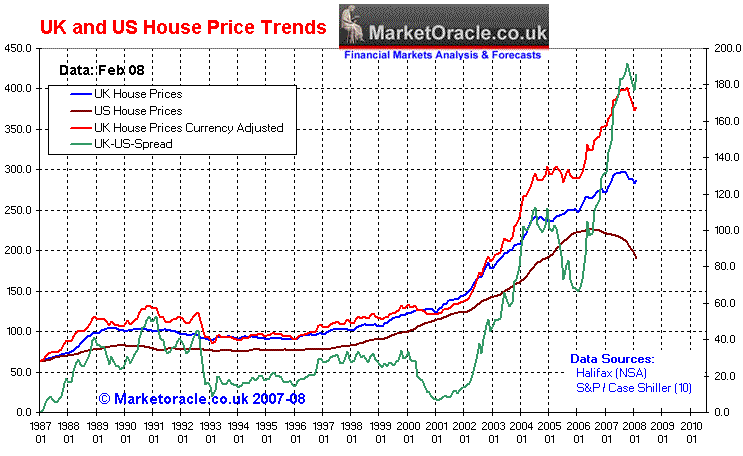
The US Housing market turned lower in late 2006, the down trend to date is accelerating as the number of unsold properties passes the 4 million mark creating a large over hang of supply. There is no technical or fundamental sign of an imminent bottom. US house prices could easily fall another 15% and then be subjected to many years of consolidation before prices can start to rise higher again. This despite the clear inflationary strategy of devaluing the US dollar as evident by the currency adjusted gap developing between US and UK house prices (green line). The US housing market is clearly in the grips of a vicious cycle of house price falls, leading to more foreclosures leading to further house prices falls. The impact of each turn of the cycle is an greater credit squeeze as leveraged banks losses and risks escalate.
The UK housing market peaked in August 2007 and to date is declining at an annualised rate of 7.5%, which is inline with the two year forecast for a 15% price drop from August 2007 to August 2009. Whilst there are many fundamental reasons for why the UK house prices have been more supported than the US i.e. limited new builds and recent influx of immigration from eastern europe. However the degree to which the UK housing bubble has been inflated gives ample scope for a serious price correction that would extend to a period well beyond the initial 2 year house price forecast period, especially if the recent immigrants flow outward during a UK recession and therefore contributing towards a glut of empty rental properties amongst the sizeable speculative buy to let sector.
Not only have UK house prices risen by 170% since January 1999, against US house prices that currently stand at up 111%. But the currency adjusted increase is 225%, where much of this increase has taken place during the past 2 years. The UK housing market seems destined to give up all of the gains made during 2006 and 2007 and therefore targeting a nominal price decline of at least 19%. Declines beyond these are dependant upon inflation and currency trends which could see a real terms inflation adjusted decline of more than 33% over a 3 year time frame (from August 07).
In Jan of 2007, an article in the Director of Finance Online documents the housing inflation’s progress, ranging from low of 7% in the West Midlands to a high of 17.5% in London.
By August of this year, that appreciation had slowed… running approx a year behind the US housing market. The Independent reports that gross mortgage lending is down about 65% from the previous year.
“The monthly numbers of approvals for house purchase, which have fallen by some two-thirds over the last year, levelled off in July,” said David Dooks, the BBA’s statistics director. “It would, however, be premature to think that the housing market will now start to recover, because overall approval activity continues to be very low. The pressures on household budgets are reflected in the relatively weak rise in individuals’ deposits and, with consumer borrowing growing only slowly it seems that consumers are acting prudently.”
~~~“We continue to anticipate a modest recovery in house purchase activity [in the second half]. But the still very low level of approvals points to falling house prices – we currently expect an 18 per cent drop by year end, and a further 9 per cent decline by the end of 2009.”
The UK did something the US did not between 2000 and 2006… they used their interest rates to attempt to control their prices… raising them for awhile before reducing them again.
This leads me to two conclusions. First, had the housing prices not risen out of control, and become over valued, the high rate of foreclosures from risky subprime ARM loans would not have had the same effect on the overall lending industry. Defaulting buyers would merely be replaced with qualified buyers for a home worth the note value.
Secondly, this is not just a US problem…. Considering the UK’s eerily parallel path, and the reality that George W. Bush has nothing to do with British regulations of lending, it’s difficult to simply tie this to a sitting POTUS or British PM. For whatever reasons the UK experienced their housing inflation, it is having the same economic effect.
EASY MONEY LED TO INFLATED US PROPERTY PRICING
So why did those home prices get driven up so high? Two reasons… first the availability of money to risky borrowers who did not have access before. And secondly, that easy money coming at a cheap rate.
As Dan Danning, editor or Strategic Investments, wrote in his article for the Daily Reckoning, The New Serfdom”, 2003 was a banner year for refinancings and rock bottom rates. By April, the refinance market dropped 30% “on a week-over week basis. That was not long after short-term bond prices cratered – and yields spiked up. Rates went up, healthy borrowers lost the incentive for refinancing and purchasing, and the run at the ARMs by the more risky homeowner began in earnest.
Now there was the opportunity for cheap money at the entry ARM rates, or taking advantage of the no-doc/low doc, stated income or interest only exotic loan packages. The new buyers did not think 3-5 years into the future at the adjusted pricing.
Regulations mandate that lenders disclose the adjustment will occur and payments will be based on a capped percentage off the prime rate. But since no one has any idea what rates will be 3-5 years in advance, it’s almost impossible to tell them what a future loan payment will be. How do you demand disclosure of a number based on a rate pulled out of the hat? Such are the pesky details of reality….
Interest only loans only work when you are guaranteed equity growth… a risky proposition if you’re in a 100% LTV mortgage. You might as well bet you’ll always have at least a full house in the local poker game with every hand.
In 2004, Federal Reserve Board governor Ed Gramlich credited the innovative prime and subprime packages for some 9 million new homeowners. In a speech to the Financial Services Roundtable in Chicago, May 2004, he also noted that “Subprime borrowers pay higher rates of interest, go into delinquency more often, and have their properties foreclosed at a higher rate than prime borrowers.”
At that time, the delinquency rates ran at around 7 percent, compared to 1 percent with prime mortgages. But the subprime borrowers were higher risk, and had less margin for area. Compound that with subprime mortgage lending increasing 25% annually between 1993 and 2004, and that 7% was starting to represent a serious percentage of notes packaged and sold on the secondary mortgage market.
With the easy money, and a drove of risky buyers flooding the market looking to purchase, sellers and listing agents commanded more dollars for the existing inventory… the ol’ finite supply vs increased demand syndrome. Builders were pounding out houses that were selling before the roofs were put on. Nothing could stay on the market long, and bidding wars became the norm, driving prices up.
But, as we see, the price inflation itself was a major contributor to the downfall… the influx of so many high risk buyers may have been somewhat managable without the increased prices. But the two together? Major components of the perfect storm.
EASY MONEY A FAULT OF NO REGULATION?
Today the instinctive rallying cry is the demand for more government regulation. Odd and rather disjointed solution when you consider you’re asking the very entity – Congress – responsible for creating and overseeing the largest secondary mortgage companies (Fannie and Freddie) to take over control and add even more regulations. Especially since they’ve had oversight, and Fannie/Freddie problems were apparent at the end of the 90s.
But let’s take a closer look at that regulation vs degulation – or the removal of government controls on an industry – argument. Curt brought you up to speed on that story with his Sept 20th post, Jimmah at fault for this financial mess. He tells of the Community Reinvestment Act that was established in 1977 by Congress, and signed into law by Carter.
From a very well written article in the winter of 2000… note PRE-GEORGE BUSH era… by Howard Husock:
The Act, which Jimmy Carter signed in 1977, grew out of the complaint that urban banks were “redlining” inner-city neighborhoods, refusing to lend to their residents while using their deposits to finance suburban expansion. CRA decreed that banks have “an affirmative obligation” to meet the credit needs of the communities in which they are chartered, and that federal banking regulators should assess how well they do that when considering their requests to merge or to open branches. Implicit in the bill’s rationale was a belief that CRA was needed to counter racial discrimination in lending, an assumption that later seemed to gain support from a widely publicized 1990 Federal Reserve Bank of Boston finding that blacks and Hispanics suffered higher mortgage-denial rates than whites, even at similar income levels.
But it was a different lending world in Carter’s era. Banking then was small, local savings banks, prohibited by regulations from interstate lending activity, and sometimes being confined to certain areas within the state. Since banking is like any other industry – it must make a profit to survive – the risk was controllable as they knew their risk areas more easily, and competition was minimal.
But upon the arrival of commercial banking in the 90s, the heavy competition caused the collapse of the small banking institution. They could not survive the competition of the national and international business lenders. But they also didn’t know the local ‘hoods, either… thus an increase in risk by being blind to the actual specifics.
Then comes Bill Clinton. Again, from Husock’s article in the winter of 2000.
The Clinton administration has turned the Community Reinvestment Act, a once-obscure and lightly enforced banking regulation law, into one of the most powerful mandates shaping American cities—and, as Senate Banking Committee chairman Phil Gramm memorably put it, a vast extortion scheme against the nation’s banks. Under its provisions, U.S. banks have committed nearly $1 trillion for inner-city and low-income mortgages and real estate development projects, most of it funneled through a nationwide network of left-wing community groups, intent, in some cases, on teaching their low-income clients that the financial system is their enemy and, implicitly, that government, rather than their own striving, is the key to their well-being.
One of the examples of the left wing community groups (and obviously their “community organizers”) is ACORN. On one of their releases, they have a report/press release proudly touting their battles against CRA reform that may exempt banking institutions from the CRA examinations of compliance – ala mandated redlining lending – for those with aggregate assets of no more than $100 million…. HR 1858.
When the House Banking Committee considered the bill, ACORN was there in force. Denied the right to testify on the proposed legislation, ACORN president Maude Hurd stood up when mark-up began and demanded to be heard. Subcommittee Chair Roukema (R-NJ) called the Capitol Police who took Maude and four other ACORN leaders to D.C. central booking where they were charged with disrupting Congress. Requests from Rep. Joe Kennedy and Sen. Edward Kennedy to release the ACORN activists failed, and it was not until Rep. Maxine Waters (D-CA) showed up at the jail and refused to leave that they were released late that night. Meanwhile, as mark-up continued in subcommittee, ACORN members again displaced the industry lobbyists who were forced to watch the proceedings on closed circuit television. When the full Committee took up the measure ACORN supplanted the lobbyists once more, this time packing the overflow room as well, leaving many lobbyists in the hallways.
Amazing they spit out the word “lobbyist” with such venom. For when you think about it, what is ACORN but just another “lobbyist” organization?? oh well… They seem to live in a alternative universe.
The problem with Clinton’s reforms is he did not take into consideration the face lift on banking. Now the bank’s efforts to prove they weren’t redlining – or showing discriminatory practices – had to be shown with “the numbers”…. In essence, having high risk loans now became mandatory. These reforms commenced Jan 1st, 1995.. just before the GOP majority Congress took over after their midterm election sweep. This was a desperate act by Clinton, rewriting the regulations, knowing it would be rejected if he submitted it to the new GOP Congress.
During the seventies and eighties, CRA enforcement was perfunctory. Regulators asked banks to demonstrate that they were trying to reach their entire “assessment area” by advertising in minority-oriented newspapers or by sending their executives to serve on the boards of local community groups. The Clinton administration changed this state of affairs dramatically. Ignoring the sweeping transformation of the banking industry since the CRA was passed, the Clinton Treasury Department’s 1995 regulations made getting a satisfactory CRA rating much harder. The new regulations de-emphasized subjective assessment measures in favor of strictly numerical ones. Bank examiners would use federal home-loan data, broken down by neighborhood, income group, and race, to rate banks on performance. There would be no more A’s for effort. Only results—specific loans, specific levels of service—would count. Where and to whom have home loans been made? Have banks invested in all neighborhoods within their assessment area? Do they operate branches in those neighborhoods?
~~~The CRA’s premise sounds unassailable: helping the poor buy and keep homes will stabilize and rebuild city neighborhoods. As enforced today, though, the law portends just the opposite, threatening to undermine the efforts of the upwardly mobile poor by saddling them with neighbors more than usually likely to depress property values by not maintaining their homes adequately or by losing them to foreclosure. The CRA’s logic also helps to ensure that inner-city neighborhoods stay poor by discouraging the kinds of investment that might make them better off.
Written in the winter of 2000… sounds like it could have been written yesterday.
In 2003 and on, the Bush WH was actively pursuing Fannie/Freddie reform since they could see the handwriting on the wall for potential massive default. By then, they had issued $1.5 trillion in debt.
Yet supporters of Fannie/Freddie (uh… DNC…) argued that tighter oversight with the changes may make it more difficult to finance loans for the lower income families. Yet it was these very loans that were at the source of the problem.
Significant details must still be worked out before Congress can approve a bill. Among the groups denouncing the proposal today were the National Association of Home Builders and Congressional Democrats who fear that tighter regulation of the companies could sharply reduce their commitment to financing low-income and affordable housing.
”These two entities — Fannie Mae and Freddie Mac — are not facing any kind of financial crisis,” said Representative Barney Franof Massachusetts, the ranking Democrat on the Financial Services Committee. ”The more people exaggerate these problems, the more pressure there is on these companies, the less we will see in terms of affordable housing.”
Representative Melvin L. Watt, Democrat of North Carolina, agreed.
”I don’t see much other than a shell game going on here, moving something from one agency to another and in the process weakening the bargaining power of poorer families and their ability to get affordable housing,” Mr. Watt said.
Will those words return to haunt them today? With our research-deficient MSM…. unlikely.
UPDATE: Now, what Congress members would like you to believe is that securitization, or the bundling of loans to sell interstate as MBSs (mortgage backed securities), then repackaged yet again for resale, is the problem. Yet intersale of assets is necessary to provide opportunity for more buyers.
The reality is that had non-risky loans been packaged, and risky loans had been avoided, none of this would have happened, and the MBSs would be stable. Thus, the problem is not that loans were bundled, but that BAD risky loans were bundled.
So here’s the point. Before we scream for “regulation”, we need to realize it was *regulation* that put us in the quandary that placed the final component into the perfect storm…. the mandated increase of high risk loans. The specifics of any regulation/deregulation really need to be poured over carefully…
THE PERFECT STORM
The Clinton “improvement” of CRA was done in 1995. Now… look at the charts above one more time. Notice that from 1989 to 1995, the home prices remain relatively flat. Now notice that the increase in home prices corresponds to Clinton’s revamping of CRA, and his new mandates to prove compliance by firm numbers.
Now we see a clearer picture to “the perfect storm”.
The mandated easy money (documented by actual loan numbers and not intent) to high risk lenders was accomplished by the creative loan packaging…
The influx of so many buyers from the low rates and exotic loan packages flooded the inventory with ready and able buyers…. this led to overinflated prices of homes and the big boom of 2004-2006…
… which led to the inevitable foreclosures of the high risk buyers. They were unable to refi because of the inflated value…
…finally setting the stage for the high lending losses today – money the banks put out for inflated property values that can not be recouped in a resale in today’s market.
Not so much of a surprise when you see the overview, yes?
Now, let’s reconsider that $700 bill bailout in bad notes… is it really that much? How many of those homes can be resold for a realistic value? Let’s say the average overinflated value in the notes is 25%. That’s $125 billion in lost equity. And that’s considerably less than the $700 billion.
Are we “over bailing” the boat??
Vietnam era Navy wife, indy/conservative, and an official California escapee now residing as a red speck in the sea of Oregon blue.

MSBees Extra treasures could be,though with all those car payments doubt he can afford my home BYE
MISSY, hi, that is a smart way to earn extra, money If you can repair the problems of the house,
specialy today you would have the agency to have the expert going around, and see if it is environment adequate or if not you can’t sell it before it’s done.
Forbes and all the rest of you brainiacs have got to get real. Why do you keep on trying to make your voodoo turnaround work? The Greedy financial geniuses forced the economy out of kilter and the genie is not going back into the bottle until the ones who pulled it out remove the excess fat so that it can fit back into the bottle.
There are more foreclosures than the industry have brought to light. The industry is allowing some defaulters to remain in their homes FREE, because they don’t want the REAL number of foreclosures to show up on their books. My daughter is one of those lingering in limbo for more than a year. Still trying to manipulate the system hoping they don’t have to pay the pauper for their dirty deeds of creating this greedy monster in the first place. They still want to continue their runaway greed. But, I don’t think it’s going to work. They, the financial industry, has created its own checkmate and what they leave us – the opportunity of taking installment loans in order to live for another paycheck. I predict that one, of two things, will happen. The industry will either eat their self-created losses or there will be a Worldwide financial BUST.